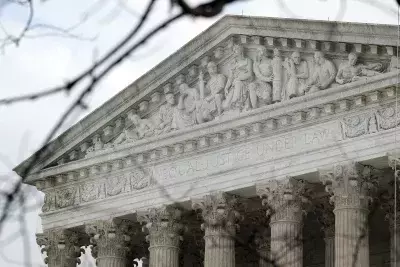
Supreme Court Rules Louisiana's Congressional Map Unconstitutional
News

Supreme Court Rules Louisiana's Congressional Map Unconstitutional

authorBy Christianne Amanpour
DateApr 29, 2026
Read Time3 min
The U.S. Supreme Court has recently issued a significant ruling concerning Louisiana's congressional districts, declaring a specific redistricting plan unconstitutional. This decision has far-reaching implications for electoral integrity and the protection of voting rights, particularly for minority communities.

Upholding Fair Representation: A Landmark Decision on Electoral Boundaries

Judicial Pronouncement on Redistricting

In a deeply divided 6-3 vote, the highest judicial body in the United States concluded that Louisiana's recently drawn congressional map constituted an unlawful racial gerrymander. This determination centered on the legislative effort to establish a second district where African American voters would form the majority.

The Diminishing Reach of the Voting Rights Act

Despite the court's assertion that Section 2 of the Voting Rights Act remains valid, this latest judgment is widely perceived as undermining the core principles of this pivotal civil rights legislation. Enacted to safeguard the collective electoral influence of minority groups during the process of redrawing political boundaries, the act's effectiveness appears increasingly curtailed by recent judicial interpretations.

Uncertainty Surrounds Upcoming Elections

The immediate ramifications of this ruling on the legislative elections scheduled for November remain unclear. With primary elections already well underway in numerous states, the timing of this decision adds a layer of complexity to an already intricate electoral landscape.

Erosion of a Civil Rights Pillar

Once celebrated as a monumental achievement of the Civil Rights Movement, the Voting Rights Act has, since 2013, faced progressive dismantling by an increasingly conservative Supreme Court. A notable exception occurred merely two years prior, when a section of the act designed to ensure minority voter participation in congressional redistricting was upheld.

The Genesis of the Legal Challenge

At the heart of this legal dispute was the redrawing of Louisiana's electoral map following the decennial population census. After extensive litigation, the state, where approximately 30% of the population is African American, eventually agreed to create a second congressional district with a majority-Black electorate. Two of Louisiana's six representatives in the House are currently African American.

Intervention and Judicial Affirmation

Typically, the agreement to create a new majority-minority district would have resolved the issue. However, a coalition of individuals identifying as "non-African-American voters" subsequently challenged the legislature's redistricting plan. The previous presidential administration endorsed their stance, arguing against the establishment of an additional majority-minority district.

The Court's Rationale

On the preceding Friday, the Supreme Court concurred with the challengers. Justice Samuel Alito, articulating the majority's perspective, stated that Section 2 of the Voting Rights Act, when properly interpreted, does not impose liability conflicting with constitutional principles. He further posited that compliance with this section could not legitimize the state's race-conscious redistricting efforts in this particular instance.

A Dissenting Voice for Electoral Equity

Justice Elena Kagan, in her dissenting opinion, expressed profound disagreement, asserting that the Court's ruling compromises its commitment to faithfully upholding the vital legislation enacted by Congress. She warned that the decision risks reversing fundamental progress toward racial equality in electoral opportunities, a right meticulously enshrined by Congress.

More Articles
News
Seniors Advocate for Immigrant Caregivers Amidst Supreme Court Deliberations on TPS
As the Supreme Court reviews the Trump administration's attempts to terminate Temporary Protected Status (TPS) for over a million immigrants, senior citizens are actively championing the cause of immigrant caregivers. Rita Siebenaler, an 82-year-old advocate, highlights the crucial role these caregivers play in long-term care facilities, emphasizing the growing demand for their services as the U.S. population ages. The ongoing legal battle and legislative efforts underscore the significant societal impact of immigration policies on elderly care.
By Ann CurryApr 29, 2026
News
Baby Teeth: Untangling the Impact of Toxic Metals on Brain Development
Researchers are utilizing baby teeth as unique biological archives to investigate early-life exposure to toxic metals and their subsequent effects on brain development and behavior in children. By analyzing the growth rings within deciduous teeth, scientists can reconstruct a chronological record of metal exposure, offering invaluable insights into how these environmental factors influence cognitive functions and overall neurological health, particularly during vulnerable developmental stages.
By Anderson CooperApr 29, 2026
News
Eagle Nest Cameras: A Digital Community's Passion for Avian Life
Eagle nest cameras have cultivated a devoted online following, transforming birdwatching into a shared, immersive experience. Viewers like Gloria Gajownik find solace and community in observing the daily lives of bald eagles, from their mating rituals to the fledging of eaglets. These livestreams offer a unique window into the avian world, fostering a sense of connection and enabling citizen scientists to contribute to conservation efforts.
By Michele NorrisApr 29, 2026
News
Federal Reserve Faces Leadership Transition Amidst Policy Debates
Jerome Powell's tenure as Federal Reserve chair is nearing its end with a pivotal policy meeting. His likely successor, Kevin Warsh, awaits Senate confirmation. The transition occurs as the Fed maintains steady interest rates, facing challenges from elevated inflation, the impact of the Iran war on energy prices, and political pressures. Warsh has pledged independence while expressing openness to rate cuts, citing potential economic boosts from artificial intelligence.
By Rageh OmaarApr 29, 2026
News
Global Push to Phase Out Fossil Fuels: A Turning Point Conference in Colombia
A pivotal conference in Santa Marta, Colombia, co-hosted by Colombia and the Netherlands, gathered over 50 nations to accelerate the global transition from fossil fuels. Amidst a warming planet and energy crises, participants aim to shift from ambition to concrete action, discussing strategies like reallocating subsidies and creating green job opportunities. This event serves as a crucial complement to traditional UN climate conferences, focusing specifically on how to phase out oil, gas, and coal.
By Ann CurryApr 29, 2026