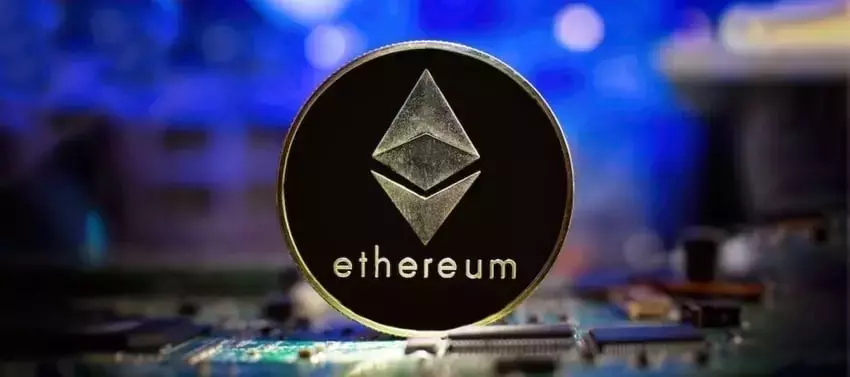
Ethereum Faces Deeper Decline Amidst Market Consolidation
Money

Ethereum Faces Deeper Decline Amidst Market Consolidation

authorBy Bola Sokunbi
DateJun 14, 2026
Read Time3 min
This article explores the current precarious position of Ethereum in the cryptocurrency market, highlighting signs of a potential significant decline. It delves into the factors contributing to this bearish outlook, including investor shifts towards traditional stock markets, substantial outflows from Ethereum ETFs, and weakening performance across its decentralized finance (DeFi), non-fungible token (NFT), and real-world asset (RWA) sectors. The analysis also incorporates technical indicators that suggest further price depreciation for the digital asset.

Ethereum: Navigating Turbulent Waters – A Looming Downturn?

Investor Sentiment Shifts from Crypto to Equities

Evidence suggests a clear rotation of investment capital by US participants, moving away from the volatile cryptocurrency market and reallocating funds into the flourishing stock market. This trend is particularly impactful on Ethereum, as data reveals a consistent pattern of considerable outflows from spot Ethereum Exchange-Traded Funds (ETFs) throughout the current year. For instance, a recent Friday witnessed $4.95 million in outflows, contributing to weekly losses totaling $14.9 million. Over the course of the month, these funds have shed more than $187 million in assets, bringing the cumulative net outflows for the year to an astonishing $1.1 billion. A similar phenomenon is observed in the Bitcoin ETF landscape, with over $3 billion in losses recorded this year.

Ethereum's Declining Momentum Across Key Sectors

The recent underperformance of Ethereum has prompted investors to liquidate their positions. Over the past five years, Ethereum has seen a substantial decrease in value by 34%, starkly contrasting with the S&P 500 Index, which surged by over 78% in the same period. Furthermore, Ethereum appears to be losing its competitive edge across various critical domains this year. The total value locked within its decentralized finance (DeFi) ecosystem has plummeted from $95 billion last August to a mere $37 billion today. Similarly, the non-fungible token (NFT) market on Ethereum has experienced a significant downturn, and its presence in the real-world asset (RWA) industry has diminished by 5.6% within the last month. These declining metrics collectively explain the observed decrease in Ethereum transaction fees this year. Moreover, demand for Ethereum in the futures market has also receded in recent months, with futures open interest dropping from a high of $62 billion last year to $22 billion currently.

Technical Analysis Suggests Further Price Weakness for ETH

Technical indicators paint a concerning picture for Ethereum's price, forecasting additional downward movement this year. The cryptocurrency has formed an 'inverted cup-and-handle' pattern, a widely recognized bearish continuation signal in technical analysis, with its lower boundary positioned at $1,750. Ethereum has already retested this lower boundary, confirming a 'break-and-retest' pattern, which typically precedes further declines. The token consistently trades below its 50-day moving average and the Supertrend indicator, reinforcing the bearish sentiment. Consequently, Ethereum is anticipated to continue its descent, potentially reaching a crucial support level at $1,500. A breach below this threshold could trigger a more significant downturn, potentially pushing the price towards $1,000 over an extended period.

More Articles
Money
HPE's Networking Sector Fuels AI Infrastructure Expansion
Hewlett Packard Enterprise (HPE) recently announced impressive Q2 fiscal results, highlighting substantial growth in its networking division. This surge, particularly in data center networking and cloud/AI revenues, underscores HPE's pivotal role in the expanding AI infrastructure market. The company also significantly revised its revenue growth projections for fiscal year 2026, signaling robust confidence in its strategic direction.
By Mr. Money MustacheJun 14, 2026
Money
Jim Cramer Maintains Optimism on Broadcom (AVGO)
Despite recent market volatility and a slight miss on Q2 revenue expectations, analyst Jim Cramer continues to express confidence in Broadcom Inc. (AVGO). This article delves into Cramer's rationale for his enduring faith, highlighting how market sentiment might be unfairly penalizing the AI chip company.
By Natalie PaceJun 14, 2026
Money
Social Security Fund Faces Depletion by 2032, Report Warns
A new report indicates that the Social Security trust fund could be exhausted by 2032, potentially leading to a 24% reduction in benefits if no legislative action is taken. This development highlights a critical disconnect between public assumptions about Social Security's stability and the looming financial challenges, urging financial advisors to adopt scenario-based planning for clients' retirement strategies.
By JL CollinsJun 14, 2026
Money
Three AI Stocks Positioned for Sustained Growth Amidst Market Fluctuations
Despite recent market volatility in the semiconductor sector, three prominent artificial intelligence (AI) companies—Taiwan Semiconductor Manufacturing (TSMC), Alphabet, and Nvidia—have demonstrated remarkable year-to-date performance, surpassing the S&P 500. This analysis delves into the underlying reasons for their resilience and potential for long-term gains, highlighting their strategic market positions and innovative contributions to the burgeoning AI industry.
By Ramit SethiJun 14, 2026
Money
Figma's Stock Rollercoaster: From IPO High to $50 Billion Decline
Figma, a prominent design software company, experienced a dramatic drop in its stock value, plummeting from an IPO high of $143 to $18, resulting in a $50 billion market capitalization reduction. This downturn is attributed to broader investor concerns regarding the software industry amidst AI advancements and the company's Q1 net loss. However, analysts remain optimistic, citing Figma's strong growth, market essentiality, and robust financial position as potential drivers for a future rebound.
By Scott PapeJun 14, 2026