Crafting Dystopian Realities: Costume Design in TV
Costume designers play a pivotal role in shaping the immersive worlds of dystopian television. Through meticulous attention to attire, they not only establish the visual aesthetic of a show but also subtly convey complex societal structures, character motivations, and thematic undertones. From the lavish eccentricities of a pleasure-driven survivor to the stark, color-coded uniforms of an oppressive regime, clothing becomes a powerful narrative tool, enriching our understanding of these imagined futures and the human condition within them. This artistic discipline transforms mere garments into vital components of storytelling, revealing power dynamics, individual defiance, and the environmental impact on daily life.
The sartorial choices in these series are never arbitrary; they are carefully crafted to deepen the audience's engagement with the narrative. Whether it's the opulent bespoke suits of a hedonistic character in a hivemind society, the contrasting wardrobes of the elite and the struggling survivors in a post-cataclysmic world, or the symbolically charged uniforms in a totalitarian state, each costume piece serves to reinforce the overarching themes. Furthermore, even in the bleakest of settings, clothing can represent acts of personal expression and resistance against overwhelming conformity, illustrating the enduring human desire for individuality and meaning.
The Symbolism of Style in Dystopian Narratives
In various dystopian series, costume design serves as a crucial element in establishing the social fabric and character identities within these bleak futures. For instance, in 'Pluribus,' the flamboyant, custom-made suits of Mr. Diabaté stand in stark contrast to the utilitarian, reused clothing of the hivemind population, immediately signaling his privileged status and hedonistic nature in a world where individuality has largely been suppressed. Similarly, 'Paradise' utilizes fashion to illustrate extreme class divisions, with the impeccably dressed elites in their underground bunkers showcasing their wealth and control, while those outside or lower in the hierarchy don vintage, repurposed garments that speak to a struggle for survival.
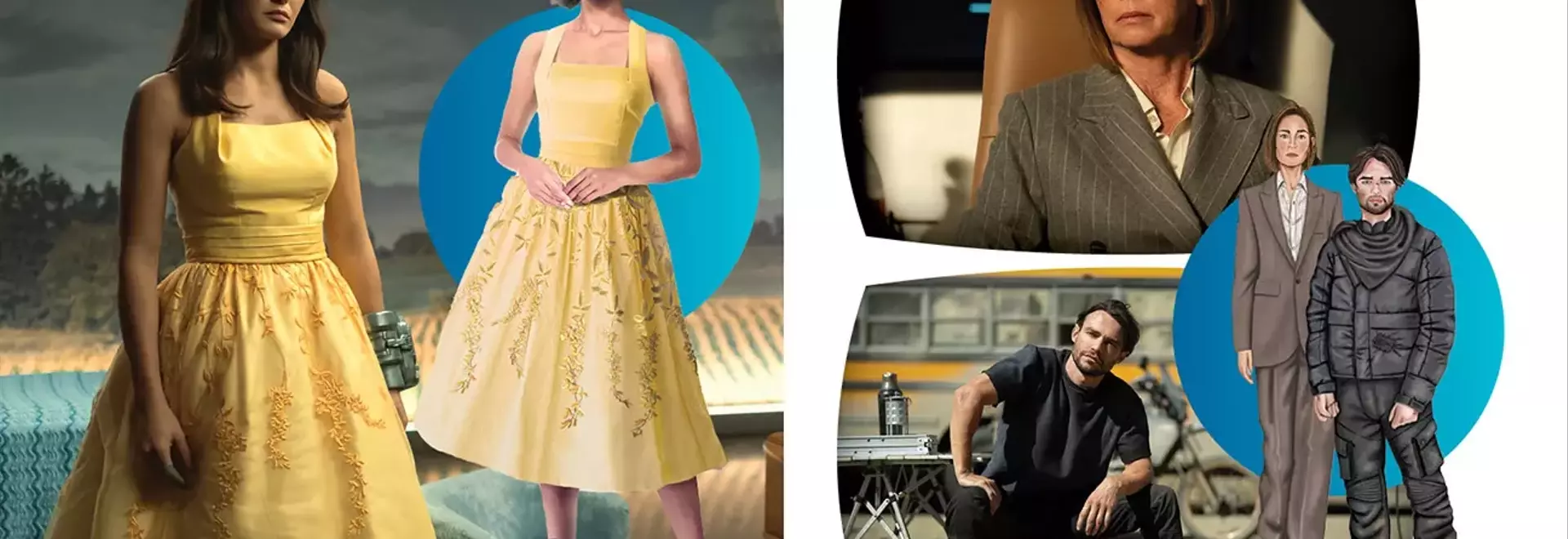
The intricate details in these costumes are far from superficial; they are deeply embedded with meaning that enhances the narrative. In 'The Testaments,' the meticulously color-coded uniforms and the quality of fabrics denote a rigid social hierarchy and the subjugation of women under a brutal patriarchal system. Characters like Agnes, with her luxurious silk attire, highlight the subtle differences in privilege even within an oppressive structure. 'Fallout' uses Lucy MacLean’s vault suit and a symbolic yellow dress to represent her journey from sheltered innocence to defiant independence. Even in 'Murderbot,' the repaired and natural fiber clothing of the Preservation Alliance team subtly communicates their philosophy of sustainability and resistance against corporate dominance, demonstrating how attire can embody a character's worldview without explicit dialogue.
Fashion as a Tool for Resistance and Social Commentary
In the challenging landscapes of dystopian television, costume choices frequently act as a potent form of resistance and commentary against oppressive forces. Characters often use their attire, or subtle alterations to it, to subtly push back against societal norms and expectations. This can be seen in 'Fallout,' where Lucy MacLean's decision to pair rugged combat boots with a delicate yellow dress symbolizes her rejection of her father's control and the patriarchal ideals he represents. This blending of elements highlights her internal conflict and her burgeoning independence in a desolate world. Her actions underscore the power of personal style as an act of defiance, even when outwardly conforming.
Beyond individual acts of rebellion, costume design also provides a visual shorthand for broader social and political critiques. In 'Murderbot,' the Preservation Alliance team's preference for repaired clothing and natural fibers directly challenges the hyper-capitalist and dehumanizing corporate supremacy of their interstellar dystopia. Their "handmade clothes" are not merely functional but represent a conscious philosophical stance rooted in sustainability, communal values, and a rejection of consumerism. Furthermore, the personalization of their uniform gray space suits during a prolonged journey illustrates a resilient human spirit, where even within uniformity, individuals find ways to express their unique identities through modifications like textile art, embroidered skirts, or graffiti-inspired patterns. These sartorial statements effectively convey their worldview and collective opposition to an unfeeling system, proving that clothing can tell a profound story beyond words.