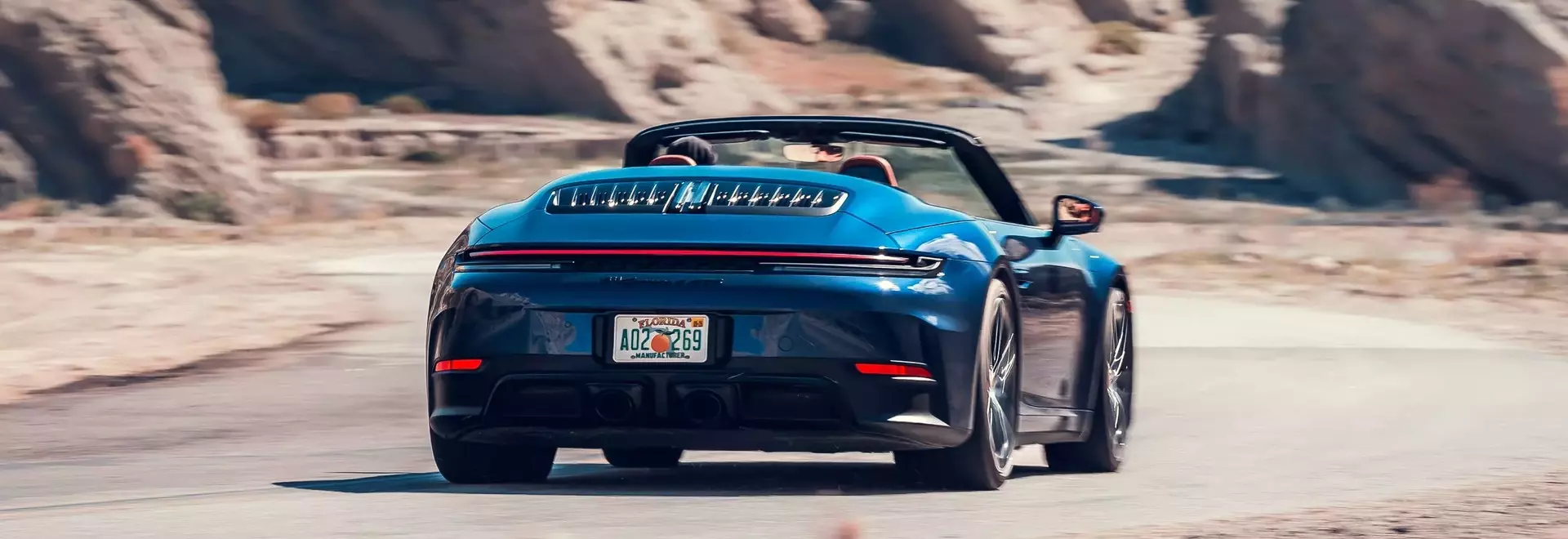
2025 Porsche 911 Carrera 4 GTS Cabriolet: AWD vs. RWD Showdown
This comprehensive analysis compares the 2025 Porsche 911 Carrera GTS Cabriolet in both its all-wheel-drive and rear-wheel-drive configurations. Through a direct, back-to-back evaluation, the article examines key differences in performance, handling, and specifications. It highlights how the AWD system, while adding a small amount of weight, significantly enhances acceleration and cornering, making a compelling case for its value despite the higher price point. The review also addresses aspects such as interior appointments, ride comfort, and fuel economy, providing a well-rounded perspective on these high-performance convertible sports cars.
The central question explored is whether the added cost and complexity of all-wheel drive are justified for a Porsche 911 Carrera Cabriolet, especially considering its typical use case. While rear-wheel drive is traditionally associated with the pure sports car experience, the article considers scenarios where AWD might be beneficial, such as in snowy conditions—though acknowledging that the convertible variant is less likely to be a winter vehicle. The test explicitly compares two 2025 911 GTS droptops, ensuring consistency in model year, testing location, and even the test driver for a precise evaluation.
Both vehicles were equipped with similar options, including the Premium package, adaptive 18-way sport seats, and a front-end lift system, among others. The all-wheel-drive Carrera 4 GTS Cabriolet commanded a base price of $187,995, an increase of $7,800 over the $180,195 for the rear-wheel-drive Carrera GTS Cabriolet. Further distinguishing the AWD model was its more premium color (Gentian Blue Metallic), a luxurious Basalt Black and Classic Cognac interior, and enhanced leather trim on the dashboard and door panels. A subtly anodized gray aluminum PDK gear selector was also noted for its tactile appeal rather than visual prominence.
Regarding weight, the difference initially appeared minimal, with the AWD model being only 67 pounds heavier (3886 lbs vs. 3819 lbs). However, a crucial detail emerged: the RWD car featured an optional 22.1-gallon fuel tank, which is incompatible with the AWD system due to the added front prop shaft. Adjusting for the smaller 5.5-gallon fuel capacity in the AWD model, the actual weight penalty for all-wheel drive is closer to 100 pounds, a more typical figure.
Both versions shared the same powertrain: a 3.6-liter flat-six engine with a single turbocharger, augmented by two electric motors. One motor, integrated into the eight-speed dual-clutch transmission, delivers 532 horsepower and 449 pound-feet of torque. The second, smaller motor on the turbocharger's intake side, effectively eliminates turbo lag. This hybrid setup provides exhilarating performance, with seamless power delivery and precise shifts from the PDK transmission, making the GTS a delight to drive in all conditions.
Despite Porsche's claims of identical 3.0-second 0-60 mph times, real-world testing revealed a notable advantage for the AWD model. The GTS 4 Cabriolet achieved 0-60 mph in a blistering 2.6 seconds and reached 100 mph in 6.5 seconds, thanks to its superior traction. In contrast, the rear-wheel-drive GTS Cabriolet managed 2.9 seconds to 60 mph and 6.7 seconds to 100 mph. While both cars shared the same quarter-mile trap speed of 129 mph, the GTS 4 reached it faster, at 10.8 seconds versus 11.0 seconds.
Both vehicles were fitted with identical Goodyear Eagle F1 SuperSport R-compound tires, sized 245/35ZR-20 at the front and 315/30ZR-21 at the rear. This commonality explains their near-identical braking performance, with both achieving a 70-mph panic stop in a mere 139 feet. While AWD enhances acceleration, it does not improve braking. However, the AWD system did contribute to better cornering, as the GTS 4 had a slightly higher weight distribution on its front axle (37.2 percent vs. 36.6 percent for RWD). This subtle change resulted in a measurable increase in lateral g-force, from 1.02 g to 1.05 g, providing a more assured and balanced feel during turn-in.
One area of concern was the ride quality, which some found excessively stiff. While the GTS suspension ensures a smooth experience on pristine roads and excellent chassis rigidity, it might be too firm for everyday driving. A rare no-cost option, the GTS suspension delete, could offer a solution by raising the ride height by approximately 0.4 inches and incorporating Carrera S anti-roll bars. The front-axle lift system, with its GPS-enabled memory function, was still highly recommended for practical use.
Minor critiques also included the overly complex 18-way adjustable seats, though these were preferred over the 14-way seats which lacked adequate shoulder bolstering. The microsuede steering wheel was another point of contention, with a suggestion to opt for the leather GT steering wheel, also a no-cost option. The convertible top, however, received high praise for its seamless operation and aesthetic appeal, whether raised or lowered. It can retract in just 12 seconds at speeds up to 31 mph, maintaining a tight and smooth profile even during high-speed runs.
Although a 75-mph highway fuel economy test was not performed, the observed average fuel consumption was 22 mpg, which is impressive and likely to surpass the EPA's 23-mpg highway rating under pure cruising conditions. Nevertheless, the absence of the larger fuel tank option in the AWD model limits its estimated highway range to 380 miles, compared to 500 miles for the RWD version.
The choice between all-wheel drive and rear-wheel drive for the Porsche 911 Carrera GTS Cabriolet hinges on priorities. The AWD variant delivers undeniable performance advantages in acceleration and handling, making it a highly compelling option for enthusiasts willing to pay the premium. The minor trade-offs, such as a slightly reduced fuel range due to tank size limitations and a firmer ride, are outweighed by the enhanced driving dynamics. Ultimately, the 911 Carrera 4 stands out as an exceptionally capable and rewarding sports car, whether in GTS trim or not.